

It’s peak summer camp season, and I recently found myself doing activities that would have fit right in around a campfire – ice breakers, group exercises.
The only difference was that I was at a conference learning how to become a better facilitator.
And as I looked around the room, I couldn’t help wondering how these same exercises would go over with a group of Fortune 500 executives. Maybe not so great. I became curious, though, about how facilitation – true facilitation – shows up throughout the life of a consulting engagement, and whether there’s value being left on the table.
There’s a tension in professional services work that no one likes to name out loud. On one side sits the consultant as an expert – the person who arrives with data, frameworks, and hard-won perspective – who synthesizes their knowledge into a recommendation and confidently delivers it in a polished deck. On the other sits the consultant as a guide, the person who creates space for clients to do their own thinking, surfaces what a room collectively knows but has never said, and holds back their own conclusions because the client’s ownership of the outcome matters more than the elegance of the analysis.
Many companies hire consultants who default to the first mode. It’s what the industry was built around, and it’s probably where clients believe they’re getting the most value. But it has a blind spot, and that blind spot becomes consequential in particular kinds of engagements: when what you need isn’t a deliverable but a shared understanding, not a recommendation to be handed down but a strategy your organization actually believes in enough to execute.
Advisory vs. Facilitation
The difference between advisory and facilitation is deceptively simple: It’s where the relevant intelligence lives.
In the advisory model, truth lives outside your organization: in data, benchmarks, competitive analysis, and the consultant’s accumulated pattern recognition from having seen 50 versions of your situation elsewhere. The consultant gathers that external truth, synthesizes it, and presents it back to you.
In the facilitative model, truth lives inside your organization. The relevant knowledge is tacit and distributed. It’s the institutional memory, the cultural intuition, the divergent perspectives of people who are rarely asked the same questions in the same room. The consultant’s job is to design the conditions under which the client can surface insight from themselves.
Applying the advisory model to a situation that calls for facilitation produces decisions that look correct on paper but collapse on contact with your organization, because the people responsible for implementing them were never genuinely part of making them. People commit to what they help create. Consulting engagements that require real change within your organization should be designed with that fact in mind from the beginning.
How to Choose the Right Approach
The good news is that this isn’t a binary choice, and it doesn’t have to be a fixed one either. The right approach can and should shift as an engagement evolves. A good consulting partner will adjust accordingly. One that always defaults to the same mode from scoping through delivery will likely fall short of delivering everything your organization deserves.
Here’s some guidance on when to lean on facilitation and when to lean on advisory:
| You probably need facilitation when… | You probably need advisory when… |
| The goal is shared understanding, ideation, or surfacing tacit knowledge. | The goal is a deliverable with defined success criteria. |
| Focus is internal: vision, values, strategy ownership. | Focus is external: market sizing, competitive positioning, financial modeling. |
| Multiple stakeholders within your firm have legitimate views. | One or two stakeholders within your firm own the outcome. |
| Successful implementation requires behavioral or cultural adoption. | Implementation doesn’t change how your firm thinks or works. |
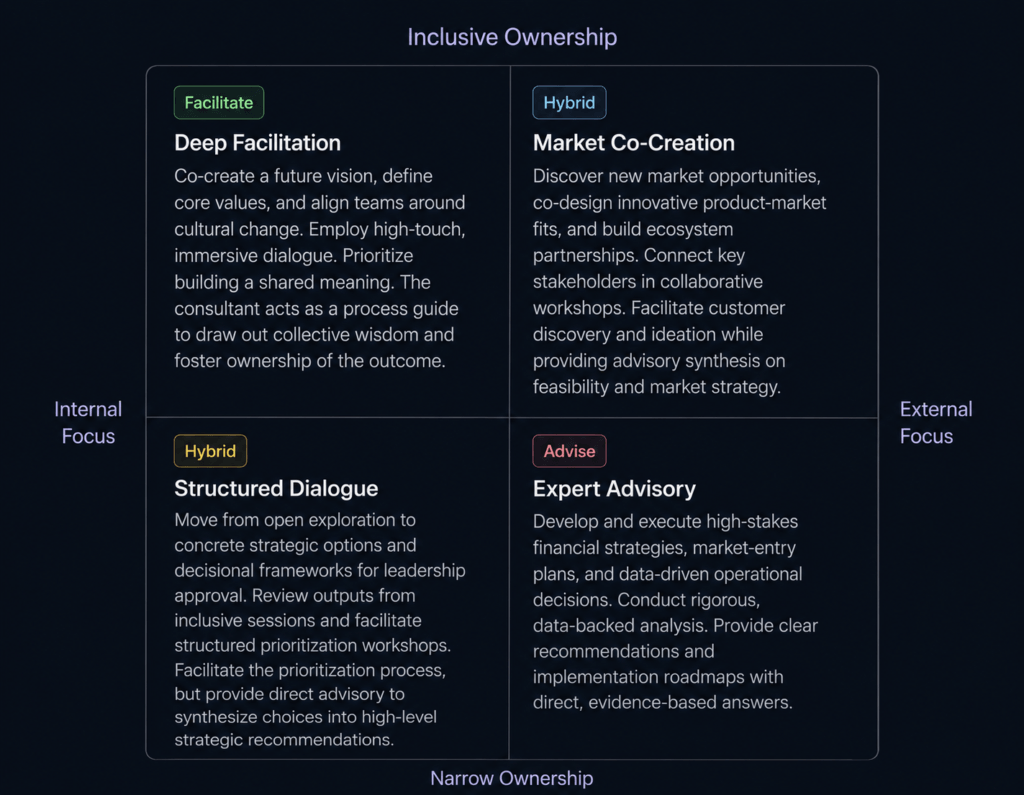
When different factors are considered together, four broad options emerge to describe the territory between advisory and facilitation.
What Changes in Practice
Consider what a typical strategy workshop looks like. A pre-read lands in your inbox a few days before. The session opens with a presentation of findings. Your team is asked to generate implications and assign priorities. The whole structure assumes that the useful work is decisional, that your job as the client is to react to content the consultant has already organized.
There’s nothing wrong with that format. It’s rigorous, respects your time, and contributes to the production of deliverables. That said, it limits the slower, messier work that enables greater depth: sitting with a scenario long enough to genuinely inhabit it, letting competing interpretations surface, or discovering what you think by saying it out loud to peers who will push back. A more facilitative approach would begin with storytelling before moving to comparison and implication. It could treat the workshop as a meaning-making exercise instead of a decision-making engine. It could generate better inputs by not rushing past the ambiguity.
If the idea of taking a slower, more facilitative approach raises a concern around scope creep, know that facilitation doesn’t have to involve multiday, off-site workshops. Lighter-touch facilitation can be embedded in regular check-ins and structured around key transition points, to create a through-line of reflection without significant increases in cost or time.
When bringing on consultants, one of the most important questions decision-makers can ask is: Given what we’re trying to achieve, are we getting the right kind of help? Collaborating with consultants to choose the approach that best fits your objective, your team, and your broader organization will result in more valuable work.