
Insights
About Us
Meet our new Convergence Outlook – the first of its kind – built for an era where technologies, capital, geopolitics, climate, and human behavior collide to reconfigure the future. It’s a playbook for leaders willing to practice creative destruction on purpose: dismantle what worked yesterday before the world does it for you.
Click the “Get Access” button below to provide your details. After submitting the form, you’ll receive a link in your email to download the Outlook.


For nearly two decades, trend analysis has helped leaders anticipate change by revealing early patterns across technology, science, economic systems, environmental conditions, and social behavior.
That work remains essential. At FTSG, we continue to track trends rigorously, because early signals of change still matter. But the environment leaders are operating in today has shifted in a fundamental way.
The future no longer arrives one trend at a time.
Technological progress, scientific breakthroughs, regulatory shifts, capital constraints, geopolitical pressure, and human behavior are increasingly interacting with one another. Barriers between systems have disappeared, as the forces of disruption amplify, accelerate, or destabilize one another. Change now spreads sideways as fast as it moves forward. The result is disruption that is faster, broader, and harder to isolate. In this environment, understanding individual trends is necessary, but it’s insufficient.
That gap is why we created the Convergence Outlook.

Most leadership teams believe they are preparing for the future, but there's an important distinction: Whether they are building the capacity to act on what they see or simply becoming more informed observers of their own disruption. This assessment, based on two decades of working with leadership teams navigating structural change, will reveal your positioning. The quadrant that describes your organization today matters far less than the decisions required to occupy a different one.
In the past year, something counterintuitive became painfully obvious: The greatest threat to any organization isn’t disruption from the outside. It’s the refusal to destroy from within.
This idea isn’t new. Economist Joseph Schumpeter described it in 1942 as creative destruction – the process by which new innovations relentlessly displace older technologies, companies, and business models, continually reshaping the economic structure from within.
For organizations clinging to what worked yesterday – led by people who assume past success guarantees future dominance – the outcome is predictable. They won’t fail dramatically. They will calcify. And then they’ll become irrelevant as the world reorganizes itself without them.
There is an alternative. A willingness to deliberately, strategically dismantle what once created success before the market makes that choice for you.
We know this because we just did it to ourselves.
Among the first of its kind, the annual Tech Trends Report was our marquee publication for nearly two decades. It reached millions of readers each year. It informed strategy inside organizations around the world. It framed what came next.
But even with all that data, any PDF compendium of trends isn’t useful in 2026 the way it was when we launched our report.
So we recognized our innovation for what it had become: a once-great idea worth destroying.
What you’re reading now is a fitting evolution because we’ve entered a Convergence Era – defined not by isolated trends but by the collision of technologies, capital flows, geopolitics, climate pressures, and behavioral shifts at scale. Across industries, these convergences are taking the structures that defined the last era and composting them into raw material for the next.
At FTSG, we are still tracking tech trends. They remain essential inputs to scenario planning. But we now see a critical mass of convergences that are dismantling foundational assumptions about how markets function, how institutions scale, and how value is created and captured.
So, let me be direct.
Too many leaders lack a clear, articulated vision for the future, leaving their teams hyper-focused on what’s trendy and fixated on the next few quarters. This is an abdication of responsibility. Now is the time to ask extraordinarily difficult questions, like “What are we willing to let die on purpose so that something more valuable can live?” I know this type of question runs counter to a leader’s instinct, honed by decades of moat-building and margin-protecting. It requires the discipline to see yesterday’s greatest strengths as tomorrow’s most dangerous liabilities.
The most valuable leaders in the Convergence Era won’t be the ones who built empires but the ones willing to burn them down at the right moment, and build again.
AI drags the cloud back to Earth.
Biology becomes editable infrastructure.

The end of one-size-fits-all computing.
Empathy is a scalable digital service.
Your doctor arrives after the algorithm has already intervened.
Surveillance is the path of least resistance.
Employment stops being the engine of economic growth.
The average human becomes a platform for upgrades.
Agents dismantle the internet that commerce was built on.
Biological and machine intelligence merge into adaptive systems.
A convergence is when multiple trends, forces, and uncertainties intersect and interact to create a combined impact that is greater – and often different in kind – than the sum of their individual effects.
Convergences:
Trends show direction. Convergences expose system-level change. Scenarios test how trends, convergences, and uncertainties could shape different futures. Strategy must hold across all three.

Convergences happen all the time. What matters is when many happen at once. When enabling conditions align, interactions intensify and separate shifts begin to move together. That clustering marks a convergence cycle. In a convergence cycle, disruption accelerates and competitive positions reset faster than organizations expect.
We’ve seen this happen before.
At the start of the industrial revolution, steam power, mechanized production, falling transport costs, expanding capital markets, urban labor mobility, and new energy systems aligned. As wealth and power shifted away from land and monarchy toward industry and finance, the old order lost its grip. Institutions built for agrarian life struggled to contain industrial speed.
After World War II, the US accounted for nearly half of global industrial output. The Bretton Woods system reset global finance. The GI Bill expanded higher education at scale. The interstate highway system rewired domestic commerce. Oil flowed cheaply and predictably. Economic power shifted toward large industrial firms and a new managerial class, and global rules were redesigned around American dominance.
By the late 1990s, widespread PC adoption, commercial internet access, telecom deregulation, and venture capital expansion aligned. Search engines, online marketplaces, and digital payment systems scaled globally. New digital business models overtook legacy media, retail, and financial firms. Established players reacted only after markets had already shifted.
The conditions present today indicate that we’ve entered a new convergence cycle.
Conditions that make a convergence cycle possible:

We’ve designed the Convergence Outlook to be provocative but practical.
Each section includes decision frameworks; no-regrets moves; actions to pause, accelerate, or reframe; and pragmatic scenarios that surface second- and third-order effects. Consider these your tools to stress-test your strategy across the enterprise.
In our experience, the most impactful CEOs know that the future is multivariate, and the sharpest leadership teams make time for meaningful debate about those variables. “Meaningful” implies that you’re covering new ground, confronting cherished beliefs, and forming new perspectives.
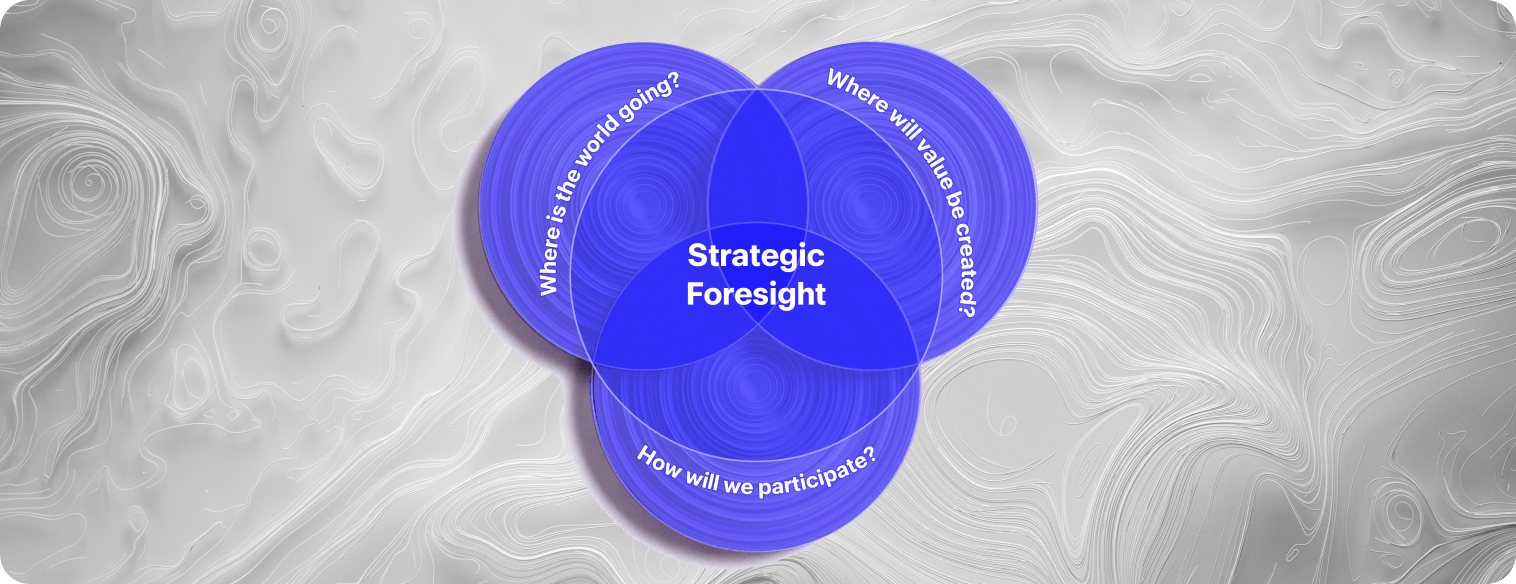
The Outlook is therefore structured to catalyze productive debate about your future readiness—and it should complement your planning. Strategic foresight begins with three deceptively simple questions: Where is the world going? Where will value be created? And how will we participate?
Each section of the Outlook offers ample fodder to discuss these questions during board meetings, executive sessions, capital allocation discussions, R&D prioritization, product roadmapping, and brand strategy resets.
Forget the full report for a minute. Here’s what’s actually happening, stripped down to the parts that matter: seven shifts that sound like science fiction but are already rewiring how the world works. They explain what is genuinely different about the world now, and what that means for everything else.
Biometric systems now identify you by default—through your face, gait, voice, and movement—turning everyday life into continuous authentication without your witting participation.
As robots and AI agents replace routine physical and cognitive work, income and power concentrate around those who own automated capacity rather than those who sell labor.
Compute now follows power plants, water rights, and political borders, fracturing the once-borderless internet into energy-constrained, geopolitically defined infrastructure blocs.
Systems no longer wait for you to act. They intervene preemptively based on forecasts of what you’re statistically likely to do.
We’re financing our own surveillance through smart devices, loyalty programs, and services that feel optional but become structural.
As biology becomes programmable and sensing becomes continuous, enhancement shifts from extreme biohacking to mass-produced, system-defined upgrades.
AI systems now provide validation, reassurance, and companionship at scale, replacing relationships with people to platforms designed for sticky engagement.
Future Today Institute is now Future Today Strategy Group!
