
Test the plan before the market does.
Most firms are hired to agree with your plan. We are hired to break it and surface what alignment can obscure.
FTSG’s Annual Plan Stress Test brings independent research on the structural shifts bearing on your strategy, and applies it against your plan with your leadership team in the room. We test the assumptions, choices, and dependencies beneath your plan while there is still time to change them.
The later an Annual Operating Plan is tested, the more expensive and harder it becomes to change.
The most consequential choices in next year’s plan are often made before independent pressure testing. That is the central weakness of annual planning, and it is a problem of sequence rather than of rigor.
In most large organizations, the shape of the plan settles by September and the budget commits by November. Evidence that a core assumption was wrong tends to surface the following spring, by which point changing course has stopped being a strategic question and become an expensive one.
Planning processes are naturally anchored in current performance, known competitors, existing capabilities, and the assumptions that produced this year’s results. Internal teams are well equipped to build and deliver the plan. They are not as well positioned to challenge it from an outside perspective.
The Annual Plan Stress Test supplies that outside view.
FTSG brings research on the structural shifts, emerging risks, and cross-industry dynamics most relevant to your organization. We then work with your leadership team to test the plan’s assumptions, trade-offs, strategic logic, and readiness for execution.
Independent by design.
FTSG does not sell technology implementation, run transformation programs, or staff the work that follows the recommendation.
Our advice is not shaped by what we sell next. We offer an honest reading of where your plans are sound, where they are exposed, and what must change before execution.
Two disciplines. One outcome.
Foresight tests the plan against structural change.
It identifies the market shifts, emerging risks, and cross-industry dynamics your strategy may be underestimating or implicitly betting against.
Backcasting connects the strategy to execution.
It works backward from the intended outcome to identify the milestones, capabilities, owners, dependencies, decisions, and sequencing required to deliver it. Together, they help leadership build a plan that is both resilient to change and credible in execution.
A plan that cannot answer these questions with evidence is not finished.
01
Which assumptions are carrying the most strategic risk?
05
Which forces acting on us move faster or slower than our 12-month cycle?
02
Which single supplier, platform, partner, channel, or talent pool could unilaterally change our unit economics?
06
What’s happening at the fringe of our market that currently looks unserious or unprofitable? Do we know which customer segment we’re comfortable ignoring, and who’s serving them?
03
Where are we drawing a straight line from last year? Which of those trends might be bending, and would we notice the bend in time?
07
What would we currently dismiss as absurd that, if it happened within 18 months, would render this plan irrelevant? What’s the cheapest hedge against it?
04
Do we have hidden collisions? Do two or more workstreams depend on the same scarce resource — the same engineers, the same cash, the same executive attention?
08
If we hit 100% of this plan and still lose, what happened?
We don’t arrive with generic provocations. We arrive with research that makes these questions specific to your sector, your position, and the decisions directly in front of you.
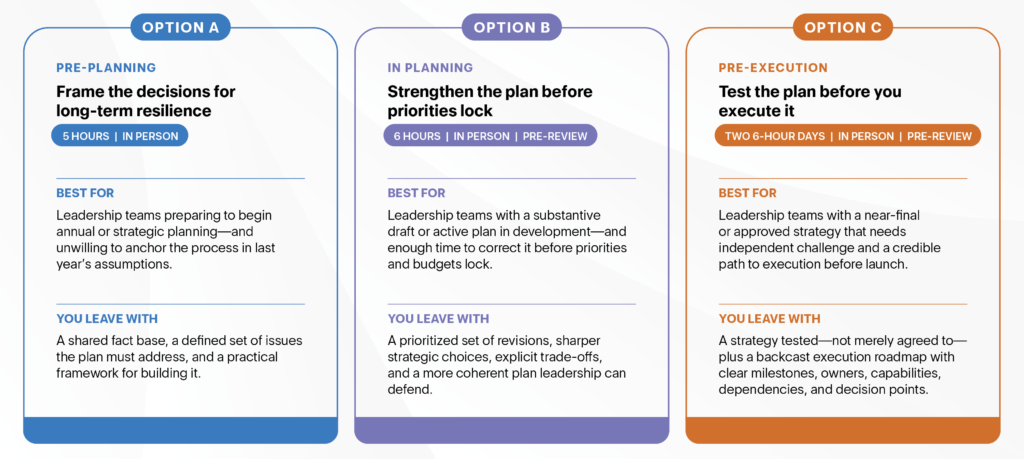
Choose the moment before the cost of change rises.
Each option below combines FTSG’s outside-in research with a structured executive working session.
What changes is when we enter, what we review, and how far we carry the work toward execution.
Optional re-perception module
A four-hour facilitated field experience designed to interrupt habitual thinking, surface weak signals, and expand the leadership team’s strategic frame.
The Annual Plan Stress Test requires three conditions.
01
There is something substantive to test.
The engagement is designed to challenge and strengthen an existing plan, strategic direction, or set of planning assumptions.
FTSG also helps leadership teams develop new strategies from the ground up, but that work is structured as a separate engagement.
02
The decision-makers will participate.
This is a working session for the leaders with the authority to change the plan—not a presentation to delegates.
A stress test attended by delegates produces a report. A stress test attended by decision-makers produces a different plan.
03
Meaningful choices can still change.
Once every priority and budget is irrevocably locked, independent challenge creates frustration rather than value.
The right time to engage is before the cost of changing course becomes prohibitive.
Why FTSG
FTSG helps leadership teams understand how structural change could reshape their markets, business models, and strategic choices.
Our work combines original research, sector-specific analysis, and facilitated executive decision-making. Every Annual Plan Stress Test is tailored to the organization, the planning horizon, and the choices leadership must make.
What it costs
Engagements begin at $126,000.
Final fees depend on the option selected, the scope of document review, and travel.
We publish the starting point to establish fit early. The first conversation can then focus where it should: on the plan, its exposure, and whether this is the right intervention.
Twenty minutes, and a straight answer about fit.
Book time with Marc Palatucci, Director of Growth & Engagement.
Marc will ask where you are in the planning cycle, what has already been decided, and where leadership sees the greatest uncertainty.
In 20 minutes, he will determine whether the Annual Plan Stress Test is the right intervention, which option best fits your needs, or whether a different engagement would be more valuable.
You will leave with a direct answer about the appropriate next step.
FAQ
How quickly can this happen?
Option A typically requires two weeks of lead time. Options B and C typically require three weeks to allow for document review. The most useful window is before strategic priorities and budgets are fully committed. If your priorities lock in September, the useful window is now.
Who should be in the room?
Up to six people, and they should be the people who can change the plan. A stress test attended by delegates produces a report. A stress test attended by decision-makers produces a different plan.
What do you need from us beforehand?
For Options B and C, we work from what already exists: strategy documents, planning materials, board presentations, financial assumptions, and the logic beneath the numbers. We do not ask you to create a new set of materials for us.
Is this a trends presentation?
No. Our research informs the session, but the output is a set of decisions, revisions, and trade-offs specific to your plan. We retired our own annual trends report for related reasons.
How is this different from a traditional strategy engagement?
A traditional strategy engagement may begin with a broad mandate to develop a new direction. The Annual Plan Stress Test begins with a strategic direction, plan, or set of assumptions already in motion. Its purpose is to independently challenge that work, identify where it is exposed, and strengthen it before the cost of changing course rises.
What if the plan holds up?
Then leadership has a plan it can defend—and knows which assumptions and choices are load-bearing. That is materially different from simply believing the plan holds up.
Do you support implementation?
We define the milestones, capabilities, ownership, dependencies, and decisions required for execution where the engagement calls for it. We do not staff or run the implementation itself.
Do you sign an NDA?
Yes, as a matter of course.
What does this not include?
FTSG does not build, staff, or run the technology, operating model, or transformation program that may follow.
We define what execution requires. We do not sell the implementation.
Where another type of firm is required, we will say so directly.